The Right Connections for Cutting Titanium
When it comes to sourcing capital equipment for machining specialty materials, manufacturers would do well to think about 10-speed bicycles: Most buyers one for recreation or exercise, and typically use only two or three of the most comfortable gears. Competitive cyclists select — and operate — all the components of their bikes (frames, pedals, shifters, wheels, etc.) to gain the maximum performance potential, whether they’re climbing mountains or racing in the flats.
Machining high-strength, high-temperature alloys like titanium is a significant mountain to climb for many shops. Machine tool builders have developed milling and turning centers that offer improved stiffness and damping on spindles, and sizable machine structures and motors, all to provide the significant cutting forces needed to cut very hard materials like titanium, while minimizing the undesirable vibrations that deteriorate part quality and tool life.
When machining titanium, achieving the maximum performance in metal removal means paying close attention to the machine tool that provides the force, the cutting tool characteristics where the cutting edge meets the workpiece, and the spindle connection — the ‘handshake’ between the machine tool and the cutter.
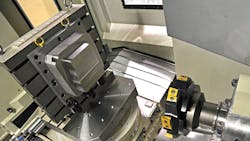
In April 2012, machine-tool builder Mitsui Seiki and tooling and tooling systems developer Kennametal Inc. conducted a test cut on a titanium (Ti-6Al-4V) workpiece on the Mitsui-Seiki HPX63 CNC horizontal machining center, equipped with four Kennametal tools, each using the KM4X 100 spindle connection.
Design for precision machining
The critical design criteria of the HPX63 include a large work capacity, with a swing diameter up to 1,050 mm and available work height (Y axis) up to 1,050 mm. The axis stroke is 1,000 mm in X and 900 mm in Z. The pallet size is 630 mm. The B-axis rotary table offers 12 rpm and high-torque, high-acceleration availability. Rapid travel rates are 32m/min with 0.5G acceleration/deceleration, and the cutting feed rate is 12 m/min.
Developed for precision work, the machine is built with castings that have been metallurgically configured to maintain maximum stiffness; its box way axis slides are hardened, ground, and hand-scraped. Positioning accuracy and repeatability is 0.001 mm. The spindle, Mitsui’s own development, automatically compensates for thermal changes and does not require a “warm up” period. The supplier offers several spindle options that match users’ needs for direct or gear drives, and the amount of torque and rpm requirements.
Overall, the ruggedness, rigidity, and precision of the HPX-63 make it ideal for machining titanium, Inconel, tool steels, stainless steels, and aluminum for parts supplied to the aerospace, energy, compressor, mold and die, fixtures and tooling, automotive prototyping, and general precision machining industries.
A spindle connection that makes the best use of available power is an important consideration to achieving maximum system performance. Most commercially available tools are solid, and the spindles have relatively low clamping force. Connection stiffness is limited, as radial interference needs to be minimized. Thus, the tolerances required to achieve consistent face contact are very tight, leading to high manufacturing costs.
Spindle/cutting tool connection
Kennametal noted the KM4X™ represents the next generation of its KM tooling system. Some systems may be able to transmit a considerable amount of torque, but cutting forces also generate bending moments that will exceed the interface’s limits prior to reaching torque limits. By using three-surface contact to improve stability and optimize clamping force distribution and interference fit, KM4X engineering results in three times the bending moment resistant capacity compared to other tool systems.
In the test cut, the HPX63 was equipped with a high-torque, high-power spindle with maximum 26/22 kW power and 1081 Nm torque. The KM4X100 spindle connection generated 85 kNm clamping force, more than twice the effect of an HSK100 and three times that of a BT50 (40 kNm and 25 kNm, respectively.)
The four different cutting tools employed in the test were (1) a 203.2-mm diam. face mill with seven square indexable inserts; (2) the same diameter face mill with seven round inserts; (3) a 76.21-mm diam., 228.6 mm long helical (HARVI Ultra™) cutter, each with five helical rows of 11 inserts; and a flat-bottom, indexable (FBI) drill unit at 125 mm diam., with six indexable inserts.
With the power of the machine tool and spindle and superior clamping force of the spindle connection, test cut results were phenomenal, across the board. For the square-insert face mill, the material-removal rate reached 88.74 cc/min. at 64 min-1 spindle speed, 12 mm depth of cut, and 45 mm cutting width, feeding at 164.3 mm/min.
At 73 min-1 spindle speed, 177.8 mm cutting width, 3 mm depth of cut, and 88.9 mm/min cutting feed, the round insert face mill achieved a 47.42 cc/min. material-removal rate.
The HARVI Ultra™ helical cutter, cutting in X and Y directions simultaneously, topped 309 cc/min. material-removal rate at a spindle speed of 171 min-1, 101.6 mm/min. cutting feed, 40 mm depth of cut, and 76.21 mm cutting width.
The FBI drill made a flat-bottomed hole in the titanium workpiece at 102 min-1 spindle speed, 10.2 mm/min. feed, and 125 mm hole diameter at 125.2 cc/min. material-removal rate. Following the first hole, the workpiece was rotated 45 degrees away from the spindle, and an angled hole was drilled pushing through the edge of the previous hole. In spite of the heavy interrupted cuts, both machine tool and drill performed well.
Maximizing capabilities
Compared to commodity grade or general-purpose machine tools, the HPX63 is able to reach 1.5 times to twice the material-removal rate when machining titanium alloy. And, the KM4X spindle connection had enough clamping force and interference fit to allow a customer to use the higher RPMs and torque levels that the machine tool and spindle can provide. More productivity potential is gained from the machine tool, and more cutting performance is gained from the tool.
Moreover, a KM4X100 spindle connection will reach performance levels of an HSK125, but makes unnecessary the longer spindle, bigger tool-changer arm, larger tool magazine, and all the related increases a larger-footprint machine would require. Sizing the right machine tool with the right tools and connection results in a system for cutting titanium and other difficult-to-machine alloys that achieves maximum productivity. The connection can stay viable right up to the machine tool’s performance potential, which will drive the greatest performance from the cutting edge. Milling, drilling, and even turning just got more productive.
Scott Walker is president of Mitsui Seiki (U.S.A.) Inc. and Mark Huston is vice president, global engineered solutions for Kennametal Inc.