
Machine shops’ and other U.S. manufacturers’ demand for new capital equipment rose to $672.7 million in June 2026, 15.6% higher than May’s result and 56.8% above June 2025. “In the first half of 2026, manufacturing technology orders totaled $3.44 billion, a 36.0% increase over the first half of 2025,” according to AMT - the Assn. for Manufacturing Technology, which compiled the data for its monthly U.S. Manufacturing Technology Orders Report.
The USMTO report tracks new-order values and machine units for metal-cutting and metal-forming machinery, nationwide and in six regions, and it serves as an index to future manufacturing activity, as machining operations invest in capacity to support their anticipated production activity.
AMT observed that the new-order volume during January-June 2026 “was the strongest half-year for the value of metalworking machinery orders since USMTO began collecting data in 1998.”
However, the 11,243 machines ordered during this period were -2.6% fewer than the number recorded during the second half of 2025, a trend that AMT has in the past attributed to the increasing value of automation technologies acquired by manufacturers together with the new machining/cutting/forming capabilities.
Referring to the January-June orders, AMT further noted: “At least some of these orders were captured in the latest report on U.S. gross domestic product, which showed that for two quarters in a row the economy was driven by outsized investment in machinery from business. While a considerable share of that growth comes from AI investments, manufacturing technology is surely an accelerant.”
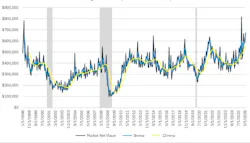
AMT highlighted the effects of demand across several sectors of the manufacturing industry, notably contract machine shops (aka, “job shops”). Typically the largest segment of machine tool buyers, their order volume has increased through the first six months the year even though the number of machine units purchase fell be almost 8.0% from the July-December 2025 period. AMT reported:
“(T)he amount of machinery (job shops) have ordered over the last several years has lagged behind the market as OEMs made the necessary investments to absorb increased production demands internally rather than by contracting with external job shops.”
In contrast, the aerospace sector led the buyers during January-June 2026, in terms of order values and machine units. The value of their orders during the first half was nearly 33.0% higher than during July-December 2025, and the number of machines ordered was nearly 25.0% higher. The sustained strength of demand from aerospace, commercial aircraft, and defense production are the sources for this growth in machine tool demand.
Also driving demand for manufacturing technology, according AMT’s summary, is the expansion in the energy sector - fueling investments by manufacturers of engines, turbines, and power transmission equipment.
“While the total orders in the first half of 2026 were comparable to the previous three halves, June 2026 orders were more than double the monthly average since January 2000. This outsized activity elevated orders from power generation and distribution manufacturers to 14% above the investments made by the automotive sector in the first half of 2026,” according to AMT.
Regionally, June demand was strongest in the West, where buyers booked a total of $150.7 million worth of new orders, 25.0% more than in May and 36.6% more than in June 2025. The region also leads in the year-to-date order total, with $884.1 million worth of new orders since January, up 63.3% more than during January-June 2025.
Only the Northeast region failed to top its May order total during June, and it only trailed that total by -1.0%. Every region is ahead of its YTD order volume for 2025, and five of those are well into double-digit increases for the current year’s demand.
The first half of 2026 featured several headwinds to business investment,” AMT noted, citing the start of the U.S. war with Iran, rising inflation, supply chain challenges, and new Federal Reserve policies. “Despite these challenges, the manufacturing economy has remained resilient, with measures of industrial production continuing to improve and capacity utilization rates holding steady at elevated levels,” the Association stated.
About the Author
Robert Brooks
Content Director
Robert Brooks has been a business-to-business reporter, writer, editor, and columnist for more than 20 years, specializing in the primary metal and basic manufacturing industries.