World’s Steelmakers Slow the Slide in Tonnage
Global steel production reversed a four-month slide of overall tons produced across the 70 nations reporting to the World Steel Association - totaling 143.8 million metric tons for October, a 1.0% improvement from September. Even so, the October tonnage is -5.9% less than the result for October 2024, and the new result brings the 2025 year-to-date total to 1.518 billion metric tons, a -2.1% decrease versus the January-October 2024 tonnage.
Most of the major steelmaking nations have been negatively affected since the U.S. imposed tariffs on imports of semi-finished steel in April - initially at 25%, now at 50% for almost all countries - but the global industry has been reducing its output for several years due to weak industrial demand and slow construction activity in various regions, and other complicating factors.
In October the World Steel statistical arm described market conditions and forecast that global steel consumption for 2025 would total about 1.75 billion metric tons, meaning a fourth consecutive year of declining demand. There are various reasons for that weakness, principally the continuing decline in Chinese steel demand due to slow industrial and construction activities there, a trend that has been underway since 2021.
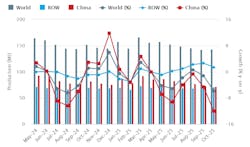
As the world’s largest steelmaker, the circumstances in China’s steel industry shapes the global result. Steelmakers in China produced 72.0 million metric tons during October, but it was the fifth consecutive month of steadily falling output, a -2.1% drop from September and a -4.6% decline from October 2024. For the current year to-date, the Chinese industry has produced 746.3 million metric tons, -2,9% less than last year’s 10-month total.
Notably, the U.S. steel import tariffs are not a significant factor in China’s steel output decline; the country accounted for less than 2.0% of all U.S. steel imports during 2024, behind Canada, Mexico, Japan, South Korea, and Germany, among others.
Another steelmaking nation seemingly unaffected by U.S. tariffs is India. That country produced 13.6 million metric tons of raw steel during October, the same as in September, but 13.2% more than during October 2024. Through October, Indian steel output is 122.4 million metric tons, 10.5% more than during the same period of last year.
The obvious beneficiaries of the tariff program are U.S. steelmakers, who have stabilized their output since April, with 7.0 million metric tons produced during October. That is just 1.4% more than during September, but 6.7% more than in October 2024. For the current year to-date, U.S. steelmakers have produced 61.4 million metric tons of raw steel, 2.1% more than the 10-month total for last year.
Also notable is that the U.S. industry has surpassed Japan and presently ranks as the world’s third-largest steelmaking.
Japan produced 6.9 million metric tons of raw steel during October, a 7.2% improvement over September but a -3.7% drop from last October. The country’s YTD output stands at 60.5 million metric tons, -4.5% compared with the comparable result from 2024.
The remaining nations on World Steel’s list of the 10 largest steelmaking nations (Russia, South Korea, Turkey, Germany, Brazil, Iran) turned in steadily positive or even results for October, but are trailing their January-October 2024 performance. One exception is the Turkish industry, which has a produced 28.1 million metric tons through October, and is just 0.6% ahead of last year’s 10-month total.
The monthly World Steel report on raw-steel production documents carbon steel produced in basic-oxygen or electric arc furnaces and cast into semi-finished forms like billets for bar and rod products; slabs for flat products; or blooms, for beam and pipe products. Specialty and stainless steel volumes are not included.
About the Author
Robert Brooks
Content Director
Robert Brooks has been a business-to-business reporter, writer, editor, and columnist for more than 20 years, specializing in the primary metal and basic manufacturing industries.